
Jio Platforms Ltd's Rs 30,213-crore initial public offering (IPO) achieved full subscription within 100 minutes of opening, making it the fastest among India's mega issues, surpassing previous records set by companies like Reliance Power.

Bonds were issued at Rs 3,119 per gramme of gold.

The National Stock Exchange's (NSE) initial public offering (IPO) is expected to shrink in size to Rs 25,000-27,000 crore, down from an earlier estimate of Rs 30,000 crore, as some shareholders are reducing their offer for sale (OFS) stake.
The National Stock Exchange of India Ltd (NSE) has received regulatory approval from SEBI for its long-awaited Rs 30,000-crore initial public offering (IPO), positioning it to potentially become the country's largest-ever public issue.
The National Stock Exchange (NSE) is reportedly planning to launch its much-anticipated initial public offering (IPO), estimated at around Rs 30,000 crore, in September, potentially valuing the exchange at over Rs 5 lakh crore.

'Read the prospectus as a capital allocator deciding whether the business deserves your capital at the offered price.'

In an effort to attract investors to the Social Stock Exchange (SSE), the bourses have reached out to the Securities and Exchange Board of India (Sebi) and the government with the industry's demand for additional benefits on contributions made towards social enterprises through the platform. SSE is a regulated platform to facilitate organisations working towards social causes to raise funds and have access to higher capital through the bourses. The platform is aimed at becoming a meeting ground for donors and social enterprises.

'We were scared about what would happen if these terrorists managed to enter the building.'

Indian benchmark indices, Sensex and Nifty, ended marginally lower after recovering from sharp intraday losses, driven by cooling crude oil prices and buying interest in HDFC Bank and IT sector stocks.

Indian benchmark indices Sensex and Nifty experienced declines in early trade, ending a two-day rally, driven by a spike in Brent crude oil prices above USD 101 per barrel and investor caution ahead of the Reserve Bank of India's monetary policy decision. Track Sensex, Nifty on October 7.

Indian benchmark indices, Sensex and Nifty, saw gains in early trade, driven by a notable drop in crude oil prices and renewed buying interest from Foreign Institutional Investors (FIIs).

Indian benchmark equity indices, Sensex and Nifty, rallied in early trade, driven by positive global market trends and easing crude oil prices, despite the US Federal Reserve's hawkish stance tempering overall sentiment. Track Sensex, Nifty on September 18.

Indian benchmark stock indices, Sensex and Nifty, rebounded significantly after a four-day losing streak, driven by value buying and strong performance in metal, telecommunication, and healthcare sectors.

Indian stock markets, including the Sensex and Nifty, experienced a significant tumble in early trade, driven by escalating tensions in West Asia that pushed crude oil prices close to the USD 100-per-barrel mark, alongside selling in IT stocks and fresh foreign fund outflows.

The IDBI Bank stake sale could generate over Rs 26,500 crore, helping the government surpass its annual divestment target, notes A K Bhattacharya.

The Reserve Bank of India (RBI) has rejected Tata Sons' application to surrender its non-banking finance company (NBFC) licence, a decision that mandates a public markets listing for the conglomerate's holding company as it is classified as an upper-layer NBFC.

Indian benchmark equity indices, Sensex and Nifty, rebounded after a two-day losing streak, driven by strong buying in blue-chip IT stocks and positive global market cues, with the Sensex climbing 330.92 points.

There is more to bourses than just men in suits and hard cash.

Stock exchanges have sought clarification on violation of disclosure norms by Adani Group entities regarding the alleged bribery case in the US and subsequent cancellation of Kenya's airport expansion deal. In its response to the case in the US, Adani Group firms on Thursday had said "there are no allegations made against the company". On clarification with regard to Kenya cancelling airport expansion and energy deals following the US bribery and fraud indictments, the group is yet to respond to the bourses.

Info Edge (India) Ltd, the parent company of Naukri.com, is undergoing a significant leadership change as founder Sanjeev Bikhchandani prepares to return as managing director and group chief executive officer. This transition follows Hitesh Oberoi's decision to step down from his executive roles after nearly 27 years with the company, though he will remain on the board as a non-executive, non-independent director.

Indian benchmark indices Sensex and Nifty closed lower, primarily due to declines in Reliance Industries and IT sector stocks, coupled with rising crude oil prices and investor caution ahead of the US Federal Reserve's policy decision.
The National Stock Exchange (NSE) and the Bombay Stock Exchange (BSE) are set to have some serious competition. Reliance Money, controlled by the Anil Dhirubhai Ambani Group, and Financial Technologies India Ltd (FTIL), which operates one of the world's largest exchange networks, are exploring the option of setting up their own equity exchanges.

Indian stock markets extended their rally for the fifth consecutive day, with the Sensex climbing nearly 384 points to close above 77,000, driven by foreign fund inflows, easing crude oil prices, and improved global sentiment following the US midterm election results.
The Tokyo Stock Exchange on Wednesday halted trading for the second time in its history after a surge in orders

The regulator has said HSE, or its subsidiaries can continue to function as any other corporate entity or any other normal broking entity, subject to compliance with applicable laws.

Mukesh Ambani fought back tears as his three children, Akash, Isha, and Anant Ambani, took the stage at the stock market listing of Jio Platforms Ltd, marking an emotional moment that signals the next generation's readiness to lead one of India's largest corporate empires.

Indian stock exchanges are actively preparing to implement a new closing auction mechanism (CAS) from August 3, aimed at enhancing transparency in determining closing prices for securities with derivative contracts.
Indian benchmark indices, Sensex and Nifty, saw declines in early trade due to escalating crude oil prices and ongoing US-Iran hostilities, which subdued investor risk appetite.

Indian benchmark indices, Sensex and Nifty, experienced a sharp decline, with the Sensex tumbling 1,247.71 points and the Nifty settling below 23,100, primarily driven by a significant spike in crude oil prices and weak global market trends.

Indian stock markets, led by the Sensex and Nifty, have extended their robust rally for a fourth consecutive day, buoyed by a significant correction in crude oil prices, a resurgence of foreign institutional investor inflows, and strong domestic Q2 earnings.

Tata Trusts Vice-Chairmen Venu Srinivasan and Vijay Singh challenge a proposed reorganisation of Tata Sons, alleging a lack of trustee consultation and raising concerns about its regulatory and financial implications.
Indian benchmark indices, Sensex and Nifty, saw a significant rebound in early trade, with the Sensex jumping 726 points and the Nifty climbing over 200 points, primarily driven by strong performances in IT stocks, HDFC Bank, and renewed foreign fund inflows. Track Sensex, Nifty on July 29.

Indian stock markets closed lower due to selling in IT and FMCG shares, triggered by renewed tensions in West Asia which led to a rally in crude oil prices and concerns over inflation and interest rates.
Tempsens Instruments India has emerged as the strongest mainboard IPO debutant of calendar year 2026 so far, delivering a 95.55 per cent gain on its listing day, surpassing all previous top performers and contributing to August being the strongest month for listing gains this year.
Indian benchmark indices, the Sensex and Nifty, witnessed a significant rally, with the Sensex jumping 2,009 points and the Nifty surging 576 points. This surge is attributed to a sharp decline in crude oil prices, hopes for a resolution to the West Asia conflict, and the Democratic Party gaining control of the US Congress in the midterm elections.
Indian benchmark indices Sensex and Nifty ended marginally lower in the special Diwali Muhurat trading session, snapping a seven-day rally amid profit-taking by investors. Despite a positive start, the Sensex dipped 28.62 points to 80,999.40, and the Nifty declined 43.95 points to 24,986.40.

Indian benchmark indices Sensex and Nifty experienced a significant slump in early trade, mirroring a bearish trend in global equities, as escalating conflict in West Asia drove up crude oil prices and intensified investor concerns.
Sebi chairman M Damodaran on Thursday suggested reduction of regional stock exchanges in the country.
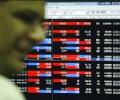
Dogged by brokers' interference, exits at the top and clash of opinions, regional stock exchanges still struggle to launch their trading platform.

The RBI can slow the rupee's fall, but lasting stability depends on tackling the root causes of depreciation and attracting foreign investment.
